

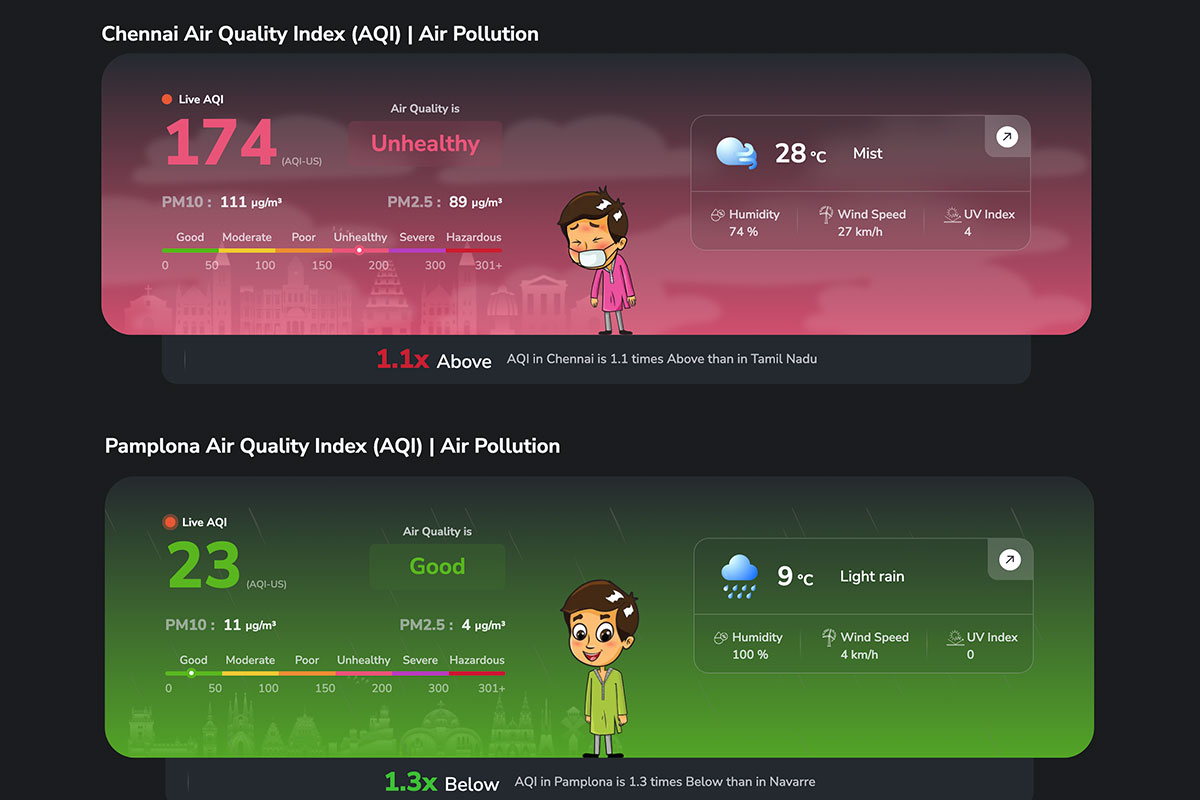
Air quality has become one of the most important environmental indicators for understanding the impact of our activities on both health and the environment. To measure it, we use the AQI (Air Quality Index), a tool that translates complex pollution data into a simple and understandable scale for everyone.
At Barranquesa, where we work to reduce our carbon footprint and move toward a more efficient energy model, we view the AQI as an essential reference for assessing the real impact of decarbonization on people’s well-being.
What is the AQI and how does it work?
The AQI is an index that classifies air quality into ranges from “good” to “injurious”. It does so by analyzing the concentration of the main atmospheric pollutants:
- PM2.5 and PM10: suspended particles of different sizes
- O₃: tropospheric ozone
- NO₂: nitrogen dioxide
- SO₂: sulfur dioxide
- CO: carbon monoxide
Each of these pollutants is measured in micrograms per cubic meter, but to make interpretation easier, the AQI converts the data into a scale from 0 to 500: from 0 to 50 air quality is considered good; between 51 and 100 it is moderate; between 101 and 150 it becomes unhealthy for the general population; between 201 and 300 it is classified as very unhealthy; and above 301 it is considered hazardous. The higher the value, the worse the air quality and the greater the health risks.
Two very different realities
To understand the importance of the AQI, it is enough to compare two cities with very different climatic and socio-industrial contexts: Delhi and Pamplona.
The indian megacity often records AQI levels adobe 250-300 for long periods of the year. On some days, especially in winter, it exceeds 400 points, a level considered hazardous. This situation is driven by a combination of factors: extremely dense traffic, high industrial emissions, the burning of agricultural waste, meteorological conditions that hinder the dispersion of pollutants, and heavy reliance on fossil fuels.
Under these conditions, the population faces respiratory risks, cardiovascular problems, reduced visibility, and a direct negative impact on productivity and quality of life.
In contrast, Pamplona is an example of relatively clean air, generally recording AQI values between 10 and 40-classified as “good”. Contributing factors include:
- An industrial base less dependent on fossil fuels.
- Greater presence of renewable energy in the regional energy mix.
- Stricter environmental regulations.
- Good natural ventilation and a more favorable climate.
The difference between both contexts shows how public policy, technology and the energy model directly influence air quality.
The role of clean energy
Air pollution is closely linked to the use of fossil fuels. This is why the shift toward clean energy (solar, wind, green hydrogen, or efficient storage) is not only a climate matter but also a public health priority.
How does clean energy help improve the AQI?
Clean energy helps improve AQI in several ways:
- It reduces direct emissions of NO₂, SO₂ and combustion-related particulate matter.
- It decreases dependence on fossil-fuel-based transport, especially through electrification.
- It enhances industrial efficiency by integrating cleaner processes.
- It drives decarbonization, which also reduces gases involved in the secondary formation of pollutants such as ozone.
Every step forward this direction results in a measurable improvement in the AQI.
Industry as a driver of change
At Barranquesa we are committed to measuring, communicating and reducing our carbon footprint. Beyond meeting corporate sustainability criteria, this reflects a growing social responsibility: contributing to a healthier environment.
Decarbonization is not an abstract concept, it means fewer emissions, better air quality, and a direct improvement in people’s lives.
A safer and more sustainable future
The AQI reminds us every day that the air quality we breathe depends directly on the decisions we make as a society. In this sense, the comparison between Delhi and Pamplona shows that the transition toward clean energy is the most effective path to reducing pollution and building a safer, more sustainable future.
At Barranquesa, we will continue working to ensure that our operations contribute to that future, committing to efficiency and decarbonization as the pillars of our activity.
Source: www.aqi.in